

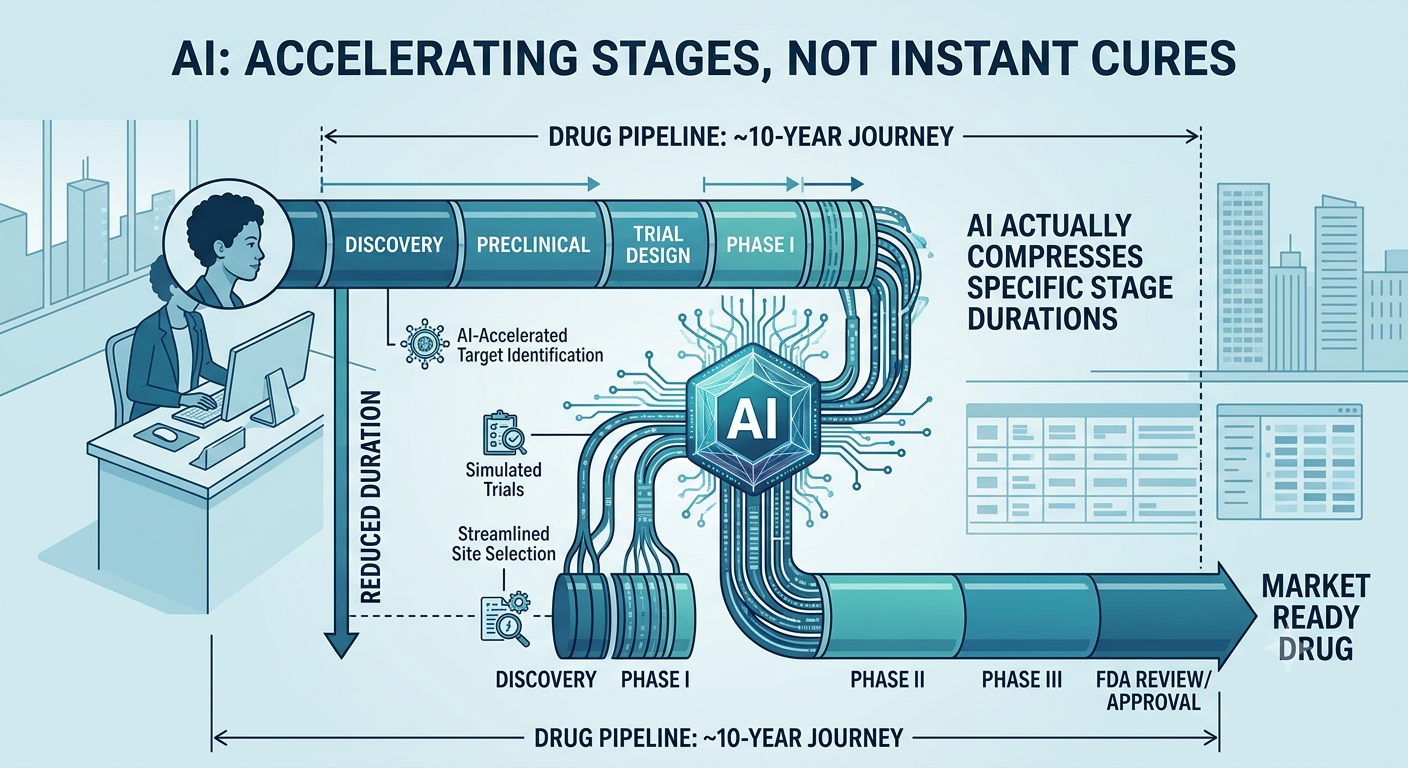
The statistic that gets repeated in every R&D conference talk is some version of this: it takes on average over a decade and billions of dollars to bring a new medicine to market, and most candidates fail along the way. AI is regularly framed as the thing that finally breaks that equation. The more accurate framing is narrower and more useful: AI is not compressing the whole pipeline, it is compressing specific, well-defined pieces of it.
Where the compression is real
Target identification and early molecule design are where the evidence is strongest. Machine learning models trained on structural and biological data can narrow a search space that used to rely heavily on trial and error, screening candidate compounds computationally before a single one is synthesized in a lab. That does not eliminate the wet-lab work — it changes what enters the lab in the first place, arriving with a higher prior probability of actually working.
Clinical trial design is the other quieter win. Patient matching, site selection, and protocol design are all data-heavy problems that AI handles well, and delays here are often the real bottleneck, not the science itself. A trial that recruits faster because it identifies eligible patients more precisely can shave months off a timeline without touching the biology at all.
Where the hype outruns the reality
Late-stage clinical development, the part of the pipeline that consumes the most time and money, is still governed by biology, regulation and human physiology, none of which move faster because a model got better. A compound can sail through AI-assisted discovery and still fail in a Phase 3 trial for reasons no algorithm predicted. Anyone promising AI will cut a ten-year pipeline down to two years is either talking about a narrow slice of it, or not being fully honest about where the actual time goes.
The realistic version
The more grounded story is a pipeline where each stage gets somewhat faster and somewhat more efficient, compounding into a meaningful overall gain but still not miraculous.
Article written and edited by the author with the support of Claude (Anthropic).